the Way of War
Presented by Aeryn on the Silver Hand server
(Originally posted 3 / 29 / 5)
This site isn't meant to be a complete guide per-se, more a few examples and a few points that may help guide you along your path as you fight in the World of Warcraft. The site is primarily designed for warriors, as the majority of the site will be descriptions on warrior talents and builds. However, the early sections will include a few pointers and explanations about weapons and weapon choice, which will apply to everyone.
Mind you, while I may discuss many issues, I may not have personal experince with them all. Some ideas will be spoken from on the basis of my experience, some are meerly constructs and may not genuinly apply to WoW.
While this guide is designed to help you choose the path that is best for your play style, remember that no build will allow you to be the absolute best in all situations. Every build has its strengths, and its weaknesss, and during the course of your play day you are likely see both situations many times. It is best if you can find a build you are happy with in most situations, and accept it as part of who you are. Noone is perfect all the time - we can only strive to be true to who we are and hope it is enough.
With this in mind, off we go.
Weapon Choice
 Dual Wield vs. Two-Handed
While Blizzards system supposedly accounts for the differences between dual wield and two-handed weapons by increasing the miss percentage of dual wield, there are factors to consider.
Purely basing numbers on statistics (not taking into account anything Blizzard has done to change the frequency)(and not counting that I am not a specalist in statistics) dual wielding weapons of 'equal' value to a two handed weapon should produce a more consistent damage rate. This has to do with the difference in varriability between the two weapons.
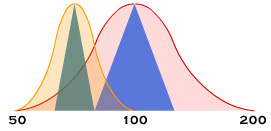
If you look at the graph to the right there are two curves. The orange curve represents a one handed weapon (in this example one that ranges from 50-100 damage) and a two handed weapon (one that ranges from 50-200 damage.) The triangle portion is the area under a normal curve which approximates one standard deviation (the values which have an ~68% chance to come up when selecting a number from that range.) As you can see the one handed (orange) section is a much smaller curve and thus a smaller cone. This means that the variability of damage will also be smaller, and when multiplied by the second one handed weapon, will produce a more consistent damage rate than the single two handed weapon.
Game Design note
There has been some conjecture on how dual wield is compensated for to ensure it matches two-handed performance. Back in beta I recall the figure mentioned of 'halving' your off handed damage. More recently (approximately March, '05) a developer mentioned that the miss rate of dual wielding was ~30% (compared to ~5% of two-handed) when fighting even level creatures and there was no mention of a damage reduction. (After the initial creation of this page screenshots were shown displaying a current halving of damage of off hand weapons.) It appears that WoW is, in fact, doing both. When comparing a two-handed weapon of a certain speed to a one-handed of equal speed and DPS, duplicating those numbers (and then halving) for the off hand will exceed the damage of the two-handed weapon. While this sounds better, it does not really change the above rough math. Due to the increased miss rate and increased damage dual wield should produce nothing more than a more consistent rate of damage when compared to two-handed. (On a damage output without doing moves manner.)
Maximum damage and Delay
One item which may be greatly overlooked by warriors, and almost certainly by non-warriors, is the issue of maximum damage and delay. While it is simple to look at the DPS rating (damage per seconds) this may not be the most important thing for a warrior during weapon choice. A warrior must consider what moves are best paired with what weapons.
Again using the example above, when we consider moves such as Cleave and Whirlwind, where the move takes a multiplier upon the maximum damage of the weapon, we can clearly see that 2 x 200 would be far more benefitial than 2 x 100, especially considering you pay the same amount of rage for using the move with either weapon. In such cases, weapons which have a high damage maximum are best paired with such moves.
However, in opposition to that, abilities which have a percent chance to occurr, such as the mace specialization of stun, would more favor a faster weapon than a slower. It doesn't take much thought to realize that a chance to stun twice in 2.5 seconds is much better than one chance to stun once in 3.5 seconds. Again, this is only true if Blizzard has not accounted for such differences by modifying the ability (or weapon proc) in association with delay speed.
Personal choice
It is my choice, with my build (a Knight of the Line) to use a very heavy 2 handed weapon (one around 3.5 delay) to have the highest possible damage I can have for when I am using the 'power moves' (Cleave, Whirlwind, etc.) and a pair of 1 handed weapons for when I want to do fast damage (both around 2-2.5 delay). Lately, however, I have found on higher creatures (such as elite bosses) you can have an extreme miss rate on dual wield, therefore you may wish to consider also finding a good light 2 handed weapon to use in those situations (due to a lower miss rate), especially if that weapon can match or exceed the dps of the dual wield items (#1 x 100% + #2 x 50%). This will allow you to keep your speed for group use as well as retain a high hit ratio.
Things to note
Just because a weapon is a 2 handed that does not mean when compared to a 1 handed it will automatically do more damage. Most weapons have 'even' damage compared to delay, thus if you find a 1 handed weapon that has a 2.6 delay and a 2 handed weapon with a 2.6 delay, of similar level, it is very likely they will have very similar damage. This is something to consider as there really is no point in taking the 2 handed weapon over the one handed in such a case, unless you have talents which boost its use.
Two handed weapons favor instant abilities, or abilities which are 'weapon damage ##%'. (Example: +60% Weapon damage.) Dual wielding favors talents or abilities that are 'chance on hit.' (Example: 10% chance on hit to do +50 damage.)
Group style
Although this is covered more in the template section, it is important to vary your weapons according to the current group needs. In my current play (mostly raiding at lv 60) I will most commonly be using dual wield in defensive stance. This allows me a high rate of damage (thus increasing the chance to generate threat both in damage and frequency) while still having the benefits of taunt and the defensive stance abilities. Also, it makes it very easy to switch from dual wield to one weapon and shield. Dual wield has the benefit of speed, which can be critical in group situations, as standing there waiting for that 3.8 second two-hander to swing can be a very very long wait when grouped.
Group style - Personal choice
Again, when in defensive stance, dual wield offers an interesting proposition. It is my personal believe that threat is generated with each hit, calculated partially based on a flat amount and partially based on damage. If this is true dual wield should generate a higher threat level than two-handed or one-handed with shield. In my experience this does seem to be the case, but not by a margin of more than10-15%. Someone with better gear who is one-handed and chain-taunting will get the creatures attention just as much as my dual wield chain-taunting. However, when comparing to non-warriors, often dual wield with taunt seems to hold aggro better than one-handed with taunt (and using shield bash, etc.)
Warrior Play
I have found, in order to be an effective warrior, your chance to critical is essential for you to do good (or great) damage. While this may not be important to a fully protective spec warrior, it is very important to all others. (I would go so far as to argue it is important to all, regardless of build, as even relying on all others to do damage, if you can do bigger damage it will have a higher chance to get the monsters attention.)
You can check your critical strike chance by opening up your "Spells & Abilities" tab and mousing over your "Attack" ability. (Note, doing this only seems acurate for melee damage, for hunters or spell casters this does not seem acurate.) This ability is boosted by critical boosting talents, critical boosting items, and Agility. In my experience, you never want this to go below about 15%, and with use of talents as well as berserker stance, this should be able to get as high as 25% or so. (It seems mine is between 17-23% right now with my current build depending on my current weapon and stance.)
When disarmed, consider using abilities that do not require a weapon, such as the shouts or Thunder Clap.
Remember, your ability to keep the enemies attention is abased on a balance of what you do and what others do. Do not be 'afraid' to let others know that what they are doing may be preventing your ability to protect them (such as mages chain-casting or attacks coming too soon before you can build up threat.)
When placing hot keys and buttons, remember that you do not want abilities that are infrequently used, or even dangerous to accidently use, next to ones that you frequently use. You may even wish to put dangerous abilities well away from other abilities or on a second hot key page (such as1/2 hour abilities, AE abilities, Intimidating Shout, etc.)
Skill / Ability notes
Piercing Howl - While this ability is good in general use, I don't know if it is worth having in the high-end PvE game. Charge is immune to its effects, and many of the enemies in high-end intances are flat out immune to speed modifying abilities.
The Builds / Templates
Here is a good talent calculator that I use often when I consider talent rebuilds. Of course, it is entirely up to you how you choose to build. I find Deflection, Cruelty, Tactical Mastery, and Impale incredibly valuable. You can look at my current build. I have had several different builds, and as such, I have percieved a number of differnet 'templates' that seem to work. I won't point out specific 'spend x points here, y points there' builds, I will leave that up to you. Instead I will point out areas of focus, and what areas (at least in theory) such a build would be strong in.
The following are 6 builds, categorized into 2 builds per group acording to their main talent pool. While you can choose to build however you like (I myself am 31 / 5 / 15) these suggestions may give you an idea of what each pairing is like. At least what I have percieved each pairing to be like, as most of these are simply constructs. I have not tried them all, but I have tried about half of them. And, of course, one build may be better suited to your liking than it was mine, so our opinions and perceptions may differ.
Feel free to go to my main site and send me an email with any constructive comments you may have about my build suggestions or perceptions.
Knights (Arms)
The knights are good for a versatile play style. They can stand as a main attacker, or a main defender. Tactical Mastery makes them viable to defend a group with in any situation, allowing freedom to swap stances nearly at will ("stance twist"). While they are flexible, they should favor weapons which will enhance a heavy hitting style by seeking the highest damage possible for both one or two handed weapons. A Blood-Knight has a higher chance to do more outgoing damage when compared to the Knight of the Line, however, someone who enjoys protecting a group may wish to choose the Knight of the Line for their ability to better hold the attention of the enemy or slight edge when taking a beating.
Knights are limited in that they will not be as good vs. single targets as a Berserker, nor will they be as able to protect a group as well as a Defender.
The preferred stance style for a Knight is whichever stance fits the current situation best. When soloing a single enemy it would be best to use battle stance. When soloing and fighting 2 or more enemies (especially if such enemies are lower level) it would be more beneficial to use berserker stance. When in a group it would be best to use defensive stance in order to keep enemies taunted (although it may or may not be necessary to change to 1 handed / shield, that will depend on the damage the creatures are doing).
Blood-Knight
Main Talent - Arms - Key: Deflection, Tactical Mastery, Anger management, Impale, Mortal Strike
Secondary Talent - Fury - Key: Cruelty, Enrage
Weapon - (Any) 2 handed, 1 handed, Dual wield, 1-handed and shield
Knight of the Line
Main Talent - Arms - Key: Deflection, Tactical Mastery, Anger management, Impale, Mortal Strike
Secondary Talent - Protection - Key: Toughness, Improved Revenge, Defiance, Improved Taunt
Weapon - (Any) 2 handed, 1 handed, Dual wield, 1-handed and shield
Berserkers (Fury)
Berserkers are great for doing high damage to fewer targets. Their style is less controlled, or calculating, than the Knights, as the Knights are more reactive to situations, while the Berserkers are more pro-active in an attempt to control by force. Unlike the Knight, the Berserker will more often stand in a single stance than choose to freely swap as needed. Berserkers should favor dual wield style, and can mix the speeds of their weapons. As dual wield is the preferred style, Berserkers may wish to consider boosting the shout lines, and using them liberally during combat.
Berserkers are somewhat imbalanced, as they favor an outgoing damage style. As many talents are based on chance, they are not as calculating as a Knight, nor can they be as precise as the Defender.
The preferred stance style for a Berserker is Berserker stance. As several talents in the Fury line are based on 'when critted' or 'after a crit', this stance favors those odds with an increased chance to crit, and reduced defence (as lower defense may increase an enemies chance to crit you.)
Blood-Rager
Main Talent - Fury - Key: Cruelty, Unbridled Wrath, Enrage, Flurry, Bloodthrirst
Secondary Talent - Arms - Key: Deflection, Tactical Mastery, Anger management, Deep Wounds, Impale
Weapon - 1 handed, Dual wield, 1-handed and shield
Berserker
Main Talent - Fury - Key: Cruelty, Unbridled Wrath, Enrage, Flurry, Bloodthrirst
Secondary Talent - Protection - Key: Anticipation, Toughness
Weapon - 1 handed, Dual wield, 1-handed and shield
Defenders (Protection)
Defenders are protectors of the group, calling all creatures attention on themselves. While a Defender will be great at PvE, some talents are completely useless in PvP (Defiance, Improved Taunt) leaving these talent points 'wasted' in these situations. While it is possible to use 2 handed weapons or a dual wield style, this is not the preferred method of a Defender, as many skills rely on the presence of a shield.
Defenders are somewhat imbalanced, as they favor a protective style, leaving damage primarily to the group. They will not be quite as flexible as the Knight, nor as damaging as a Knight or Berserker.
The preferred stance of a Defender is Defensive stance. As many protective talents benefit from the use of a shield, there really is no reason not to stay in defensive stance when with a group. However, the builds should not be so limiting that other stances are not used, but I doubt you would have as much advantage or call to do so due to the lack of damage boosting talents.
Defender of the Line
Main Talent - Protection - Key: Toughness, Improved Revenge, Defiance, Improved Taunt, Shield Specialization, One-handed Weapon Specialization
Secondary Talent - Arms - Key: Deflection, Tactical Mastery, Anger management
Weapon - 1-handed and shield
Blood-Defender
Main Talent - Protection - Key: Toughness, Improved Revenge, Defiance, Improved Taunt, Shield Specialization, One-handed Weapon Specialization
Secondary Talent - Fury - Key: Cruelty, Unbridled Wrath, Enrage
Weapon - 1-handed and shield